
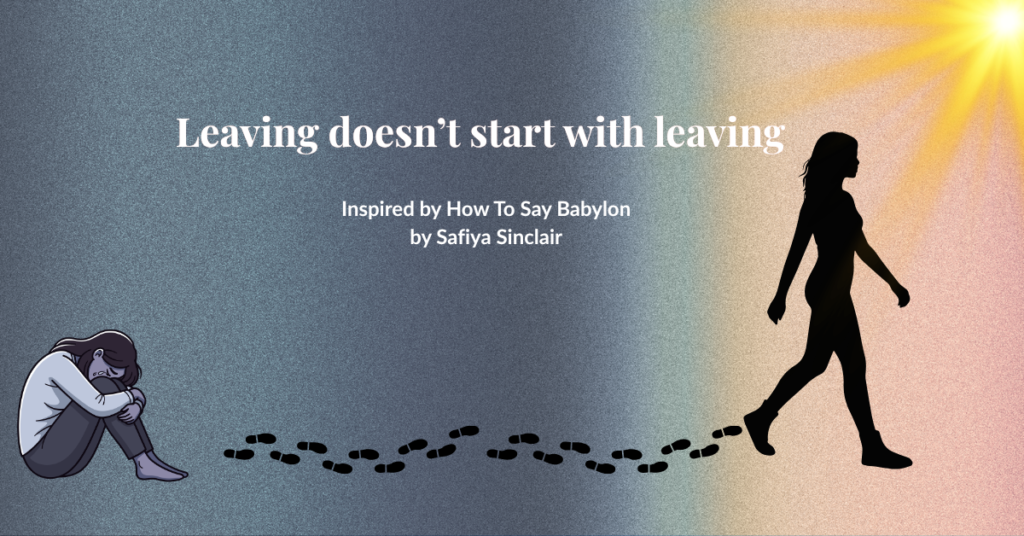
Leaving Is Not What We Think
Many people don’t realize that how to leave a toxic relationship is just as important as leaving itself.
Leaving a toxic relationship is often imagined as a single moment.
A packed bag.
A slammed door.
A final decision.
But in reality… it rarely looks like that.
Sometimes, leaving is quiet. Invisible.
Sometimes, it begins long before anyone else can see it.
Reading How to Say Babylon made me realize this:
Leaving isn’t a single act. It’s a process.
Leaving Doesn’t Start with Leaving
It doesn’t begin with distance.
It begins with a shift.
An emotional disconnect.
A quiet refusal.
Their words still hurt—but they no longer define you.
Their actions still sting—but they no longer control you.
Some therapists even suggest something that sounds paradoxical:
Leave the relationship… while still in it.
Not physically—but emotionally.
Because that’s where strength begins.
Safiya shows this through small acts of rebellion—subtle, almost invisible.
And something interesting happens:
The power dynamic shifts.
Not completely. Not safely. But enough to show that something has changed.
That’s where leaving begins.
✧ Sometimes, You Don’t Even Know It’s Toxic
One of the most unsettling truths is this:
Toxic love doesn’t always feel toxic when you’re inside it.
Especially when it is wrapped in belief systems.
Religion.
Culture.
Family structures.
Ideas about obedience, respect, or sacrifice.
In How to Say Babylon, control is not always presented as abuse.
Sometimes, it is presented as authority. As protection. As love.
And when something is normalized for so long…
You don’t question it.
You live in it.
Until something inside you begins to resist.
You Don’t Leave Alone
Deciding to leave may be internal.
But leaving itself is rarely done alone.
Safiya wasn’t alone.
Her mother.
Her grandmother.
Other women who stepped in at critical moments.
What may seem like a “small decision” from the outside can carry enormous weight inside a controlled environment.
And sometimes, it takes someone else to help you take that step.
Support is not a weakness in escape. It’s often what makes it possible.
Distance Creates Clarity
There is something powerful about changing your environment.
When Safiya’s mother traveled to the U.S., something shifted.
Not because everything changed overnight—but because she was no longer standing in the same place.
Sometimes, clarity doesn’t come from thinking differently.
It comes from standing somewhere else.
Like the saying:
You can’t see an elephant when you’re too close to it.
All you see is grey.
But step back…
And suddenly, you see the whole thing.
The same applies to toxic environments.
Distance reveals what proximity hides.
Leaving Doesn’t End When You Leave
Leaving is not the finish line.
It’s the beginning of something unfamiliar.
After Safiya left, what followed wasn’t immediate relief—but a deep emotional crash.
An identity crisis.
A loss of direction.
A quiet question:
Who am I now?
Because even toxic environments can feel familiar.
And familiarity can feel like safety.
So when you leave, you don’t just lose the relationship.
You lose a version of yourself.
And you have to rebuild.
Leaving is not the end. It is the beginning of you.
How to Leave a Toxic Relationship: Why Preparation Matters
Leaving without preparation can be dangerous.
Financially.
Emotionally.
Logistically.
In many toxic relationships, control is maintained through dependence.
Take that away—and the dynamic shifts.
Safiya’s mother once tried to leave in the heat of the moment.
She came back.
And things got worse.
Because leaving impulsively can expose how much power the other person holds.
But when leaving is planned—when there is support, structure, and foresight—
It becomes possible.
Leaving is not just courage. It’s strategy.
Keep Something That Is Yours
One of the quietest forms of resistance is this:
Keeping something that belongs only to you.
For Safiya, it was poetry.
Even when it was dismissed.
Even when it was devalued.
She kept writing.
She kept reading. Learning. Expanding.
Without even realizing it, she was building something:
A self that existed beyond control.
And sometimes, that’s where survival begins.
In the small, persistent act of choosing yourself.
Final Thoughts — The Quiet Work of Leaving
Maybe the most important thing to understand is this:
Leaving a toxic relationship is not a single act of bravery. It is a series of quiet decisions.
A slow reclaiming.
A careful strategy.And sometimes…
It begins long before anyone else can see it.
Reader Reflection
- What does “leaving” look like before it actually happens?
- Do you think preparation matters more than courage when leaving a toxic situation?